
9 FAQs About GOLi CTL Safety Burners for Multi-Unit Housing


For housing providers, replacing a burner is not just a maintenance decision. Across hundreds or thousands of units, the right choice can affect fire risk, resident satisfaction, energy use, maintenance workload, and capital costs.
That is where the ROI of GOLi CTL Safety Burners becomes important.
Instead of automatically replacing an entire range, housing providers may be able to modernize existing compatible coil-type electric ranges by retrofitting them with temperature-limiting burners. This adds another layer of cooking-fire prevention while allowing operators to keep otherwise functional appliances in service and preserve the familiar cooking experience residents expect.

See the difference between CTL vs. Cast Iron
Compare the safety and performance of GOLi CTL burners with cast iron.
Here are the questions we hear most often from housing providers.
Can existing ranges be retrofitted?

Can existing ranges be retrofitted? Yes.
GOLi CTL Safety Burners are designed to retrofit compatible coil-type electric ranges.
If the range itself is still in good working condition, operators can upgrade the burners without automatically replacing the entire appliance.
That makes CTL especially relevant for organizations managing large portfolios where full appliance replacement can quickly become a major capital expense.
Does the entire range need to be replaced?

Does the entire range need to be replaced? No — not if the existing range is compatible and still doing its job.
This is one of the biggest advantages of the retrofit approach.
Instead of removing a functioning appliance simply to improve burner safety, housing providers can upgrade the components that matter.
That can mean less disruption, lower replacement costs and a much easier rollout across multiple units.
Do residents prefer a CTL burner to a standard coil?

Do residents prefer a CTL burner to a standard coil? Yes, based on the feedback GOLi has received from residents and housing providers.
Residents still want to cook the foods they know and enjoy. A safety product only works if people are comfortable using it.
GOLi CTL Safety Burners are designed to provide a familiar coil-style cooking experience while adding temperature-limiting technology that eliminates the overheating conditions associated with cooking fires.
For residents, that means added protection without sacrificing everyday cooking performance.
What does installation involve?

What does installation involve? For compatible coil-type electric ranges, GOLi CTL Safety Burners are designed as a replacement for the existing burner.
That means operators can retrofit the range rather than introducing an entirely new cooking system or replacing the appliance.
For housing providers managing many units, this is important: the easier the solution is to install and maintain, the easier it is to scale.
Will residents need to change how they cook?
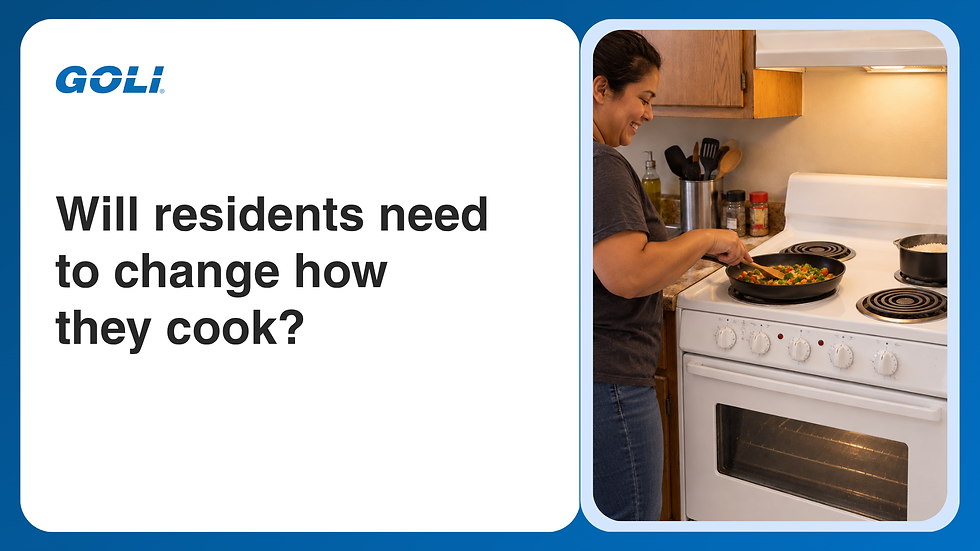
Will residents need to change how they cook? No change in cooking behaviour is required.
Residents continue using a familiar electric-coil cooking surface.
The technology works at the burner level, regulating temperature while allowing residents to continue preparing the foods the same way they normally cook.
That is an important distinction from other safety solutions that can frustrate residents, change cooking performance or encourage people to remove or work around the device.
How does the technology support cooking-fire prevention?

How does the technology support cooking-fire prevention? GOLi CTL stands for Controlled Temperature Limit.
The burner is designed to regulate surface temperature and prevent the extreme overheating conditions that can lead to unattended cooking fires.
That means the technology addresses risk at the cooking surface itself.
Alarms and suppression systems remain important parts of a fire-safety strategy, but CTL adds something different: a layer of prevention before a fire has the chance to develop.
What should maintenance teams know?

What should maintenance teams know? From a maintenance perspective, the big advantage is simplicity.
Facilities teams do not necessarily need to remove a functioning range to improve the burner technology. Compatible ranges can be retrofitted as burners need replacement or as part of a broader upgrade program.
Maintenance teams should consider:
🔹 Compatibility with existing ranges
🔹 Ease of installation and replacement
🔹 Burner durability
🔹 Electrical use
🔹 Frequency of service calls and replacements
🔹 Whether full appliance replacement is actually necessary
For a large portfolio, those small operational differences can add up quickly.
What are the potential operational and electrical savings?

What are the potential operational and electrical savings? The ROI goes well beyond the purchase price of the burner.
Housing providers should look at the total operating picture, including:
🔹 Electrical use — CTL technology can help reduce unnecessary energy consumption compared with traditional burner options.
🔹 Capital costs — compatible ranges can potentially remain in service rather than being replaced prematurely.
🔹 Maintenance — replacing a burner is significantly simpler than replacing an entire appliance.
🔹 Fire-related costs — preventing an incident can help avoid property damage, unit disruption, remediation and the operational burden that follows a cooking fire.
🔹 Resident experience — maintaining familiar cooking performance can help reduce frustration, complaints and unauthorized equipment changes.
For multi-unit operators, the real question is not simply “What does the burner cost?”
It is “What does this decision cost us across the life of the unit?”
Do maintenance staff like CTL burners?

Do maintenance staff like CTL burners? Yes.
For facilities teams, the appeal is practical: they can improve kitchen safety without automatically adding a complicated new system or replacing a functioning appliance.
A retrofit approach can fit more naturally into the work maintenance teams already do — replacing burners, turning over units and keeping existing equipment operational.
That makes CTL easier to understand, easier to deploy and easier to incorporate into a broader kitchen-safety program.
Is GOLi CTL Right for Your Properties?
If you have coil-type electric ranges across your portfolio, there is a simple question worth asking before your next burner or appliance replacement:
Can we make the kitchen safer without replacing everything?
In many cases, the answer may be yes.
Book time with Bill to review your existing ranges and see whether GOLi CTL Safety Burners could be a fit for your properties.
Start Your Path to Safer Cooking
Connect with our team to explore the right GOLi solution for you.


Comments